
On the windswept plains just south of Saskatoon, the McKercher family bet their cattle farm on apples, and built one of Canada’s most distinctive cideries.
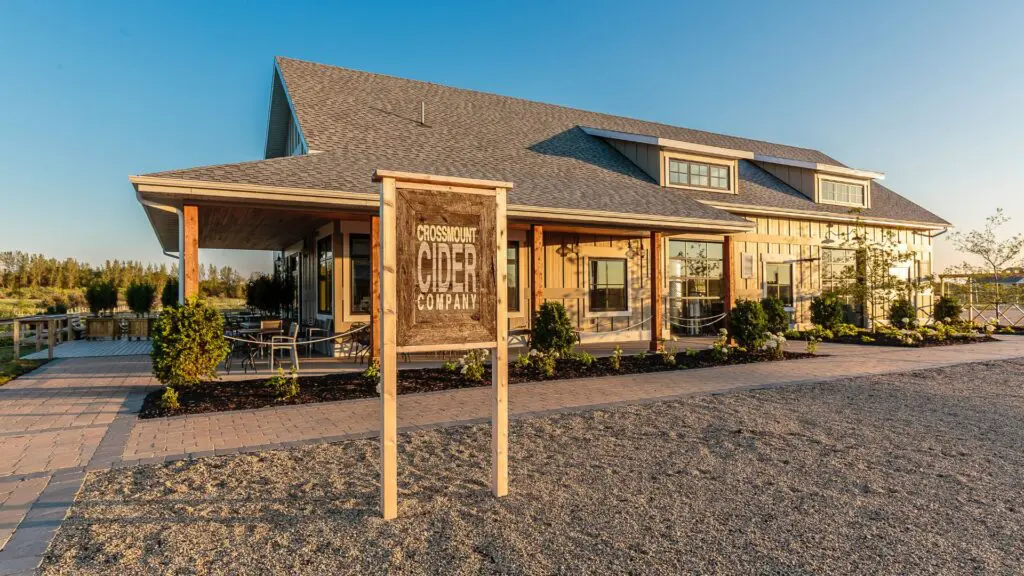
Crossmount Cider, set near the South Saskatchewan River, is a full-scale, prairie-rooted cidery with seven fermentation tanks, a tasting room overlooking rows of dwarf apple trees and a fiercely loyal following.
But the long road to now started with a question: could cider apples take root on Saskatchewan’s unforgiving prairie? For the McKercher family, fourth-generation farmers accustomed to raising cattle on frost-crusted soil, the answer began with a gamble — and 2,100 apple trees.
Before Crossmount Cider Company became the largest orchard-based cidery in the Canadian prairies, its founders didn’t even know how to make cider. “When we first started in 2016, the only thing we knew how to do was spell the word cider,” says Liam McKercher, general manager of the family-owned business. “It took months of R&D to come up with a few staple flavors you can still find on the shelf today.”
But that origin story is as fitting as any in a region where -40°C winters aren’t uncommon, and where even the idea of growing apples once seemed laughable.
Crossmount is an unlikely cider destination by any traditional measure. It sits just five minutes south of Saskatoon, in a region dominated by grain elevators and frost-hardened farmland, where canola and wheat fields stretch endlessly into the horizon. Before the orchard, the land was used to raise 400 head of Angus cattle.
The groundwork for cider making started in 2014 when McKercher’s family originally considered growing winter-hardy grapes to make wine. Around that time, an employee who was helping with landscaping happened to be a student at the University of Saskatchewan with a minor in grape breeding. He pointed out that the university had hundreds of cold-climate apple varieties that were already well-developed. He suggested they try apples instead.
That year, they planted 2,100 apple and pear trees. The varieties were experimental and unproven in commercial cider production.
McKercher understood the gamble. “At the time, few believed cider apples could be grown here,” he says. “But we didn’t want to just be a cider company that brought in juice. We wanted to grow what we pressed, to create something authentic to our region.”
Authenticity meant starting from scratch. The early harvests were meager. Their cider-making knowledge was mostly aspirational. In January 2016, after finishing construction on their cidery with fermentation tanks, a bottling line, a cooler, and a custom apple press, they began hands-on experimentation. Over the next six months, they developed the core blends that would define Crossmount’s offerings. “We did a lot of R&D, made some recipes and blends, and then by June 2016 we actually started packaging some products,” McKercher says.
Then came the famous bottle explosion. “One day I was just working in the tasting room and one of the bottles exploded. I texted our cidermaker and just said, hey, this happened. And he’s like, okay, we got to pasteurize.”
That hard-won knowledge, absorbed through mistakes and makeshift solutions, became embedded in Crossmount’s DNA. It forged their cider-making philosophy. Today, the cidery is a thriving, full-production operation with seven fermentation tanks, a semi-automated canning line and a strong seasonal lineup.
Yet the orchard remains central to the vision. All the trees are dwarf varieties grafted onto Ottawa-3 rootstock, specifically developed for frigid climates. They’re planted densely along vertical trellises to mimic vineyard-like rows. It’s practical, beautiful and easier to harvest.
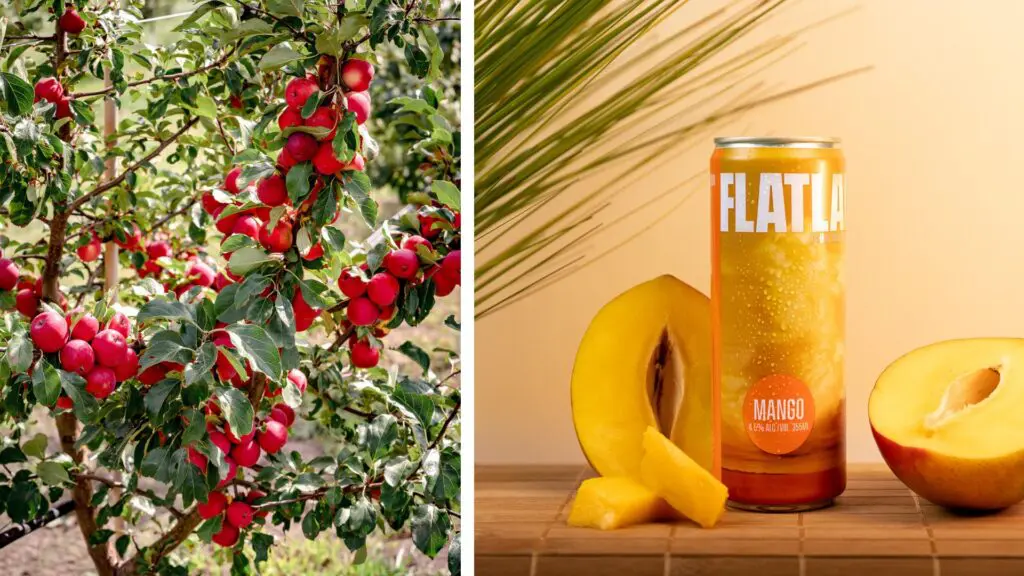
About 80% of the orchard is planted with Norkent, a prairie-bred variety producing sweet, crisp apples. There’s also Prolific, which brings tannins, and Kerr, a crabapple prized for its sugar and aromatics. “The Kerr apples will be used in the future for a prairie ice cider,” McKercher says. Even more remarkable is Crossmount’s collaboration with the University of Saskatchewan’s fruit breeding program. The cidery maintains a section of the orchard dedicated to experimental cultivars. “Our orchard is not just a production site but a proving ground for future cold-climate apple cultivars,” McKercher said.
What Crossmount is doing is not just growing apples. It’s attempting to birth a prairie fruit industry where none previously existed. McKercher’s long-term goal is to plant 10,000 cider apple trees and share proven cultivars with neighboring farmers to create a network of regional orchards. “We want to make sure we have a fruit industry here in Saskatchewan,” he says.
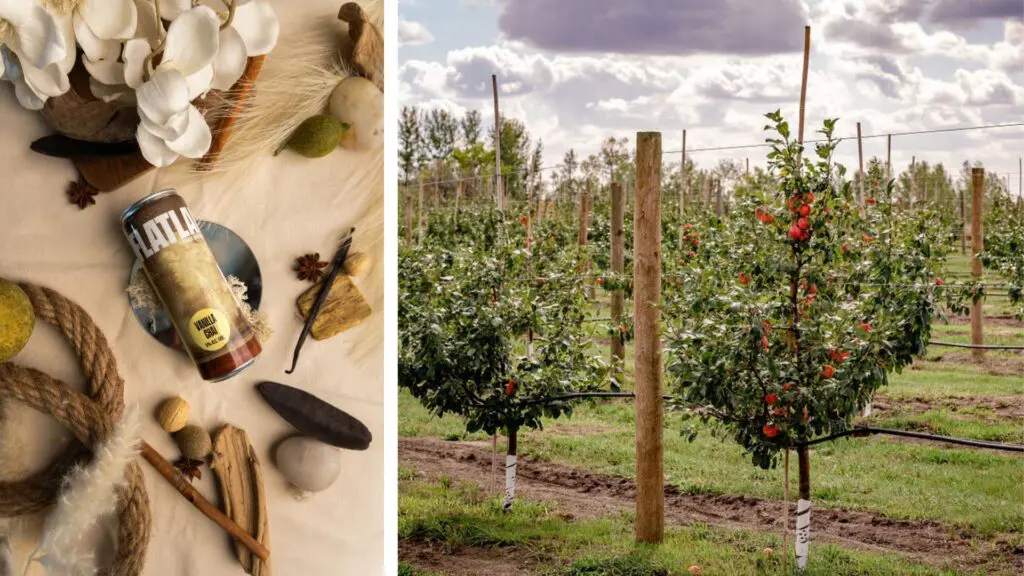
This fierce sense of regional identity seeps into every part of Crossmount, from the land to the label. The name itself is a nod to McKercher’s great-great-grandmother’s home in Scotland, the original Crossmount. “In Scotland, you have the Highlanders and the Lowlanders. In Saskatchewan, you have the Flatlanders,” McKercher says.
Flatlander, the name of Crossmount’s flagship cider line, blends humor with humility on every can. Each label features prairie in-jokes: “It’s -40 but at least it’s a dry cold,” “Don’t forget to plug your car in,” or “Watch your dog run away for three days.” According to McKercher, “They’re designed to make people smile and feel seen. Flatlander represents who we are: honest, unpretentious and prairie through and through.”
Beyond the orchard and branding, Crossmount has evolved into a full agri-tourism destination. Visitors can stroll through tidy rows of trellised trees, sip cider flights in the light-drenched tasting room, or rent cozy domes that overlook the frozen prairie in winter. The orchard becomes a year-round canvas for weddings, winter skating or a quiet moment under Saskatchewan’s famously endless skies. There’s also an on-site restaurant, event center and a small ice cream shop. The entire setup is meant to offer something immersive and tangible. “There is a distinct sense of place in everything we do,” McKercher says. “For us, cider isn’t just about fermentation. It’s about the land and the prairie life.”
Community is woven into the brand. Each autumn, Crossmount invites neighbors to bring in surplus backyard apples — windfalls and all — for a one-of-a-kind community cider. The result is more than just a seasonal release: it’s a bottle infused with collective pride, with proceeds benefiting local charities. “It’s a way for people to give back using what grows in their own backyard, and the response has been incredible,” McKercher says. The cidery also hosts Cider & Yoga events every Wednesday, where participants donate directly to a featured nonprofit. “Last year we raised just under $6,500 from yoga donations,” he says. “And just under $10,000 for a breast cancer awareness cider.”
As Crossmount’s cider offerings expand, so too does its reputation. Seasonal and small-batch releases like Pina Loca (pineapple), Jalapeño Pear, Apple Pie (infused with cinnamon and nutmeg), and Vanilla Chai continue to push the envelope, alongside prairie-forward blends featuring Saskatoon berries, chokecherries and haskap. “We decide what to bring back based on a mix of customer feedback, sales velocity and production feasibility,” McKercher says.
Despite the range, his personal favorite right now is Crossmount’s 2025 Estate Series cider. “It’s made from 100% apples grown right here in our orchard and from the University of Saskatchewan. This year is the best one yet. It’s a more structured, drier cider with layered aromatics and a backbone of acidity that really reflects our growing conditions. It’s not just a beverage. It’s the culmination of a decade of hard work, tree by tree. Every time I have a glass, it reminds me why we started making cider in the first place.”
Looking ahead, McKercher envisions a future where prairie-grown cider becomes more than a niche. “In the next five to 10 years, our goal is to establish Crossmount as a leading orchard-based cidery not only on the Canadian prairies but within the broader North American cider landscape,” he says. That includes scaling production, entering select export markets, and continuing to invest in cold-climate research.
“Great cider doesn’t just come from BC, Washington, Michigan or Europe,” he says. “It can come from right here in the heart of the Canadian prairies.”